
Study on Multiplier Effecta of Social Protection Expenditure in Rwanda
The Social Security (Minimum Standards) Convention No. 102 adopted in 1952 established a worldwide-agreed minimum standards for social security relating to medical care, sickness, unemployment, old-age, employment injury, family, maternity, invalidity and survivors’ benefits. The Convention stipulates guidelines for countries to achieve the tripartite objective of raising the percentage of the population covered by social protection schemes, level of minimum benefits to be secured to protect persons and streamlining conditions and period of entitlement to benefits (ILO, 1952).
Climate, Environment and Natural Resources sector working group
This study reviewed how Rwanda’s Climate Change, Environment, and Natural Resources Sector Working Group (CENR-SWG) and its Thematic Working Groups function. It calls for stronger coordination, inclusive participation, evidence-based decision-making, and sustainable financing. Key recommendations include establishing a dedicated secretariat, creating a basket-funding mechanism, strengthening technical capacity, and developing a national policy framework to enhance effectiveness and alignment with Rwanda’s climate and development goals.
CDP Strategic Plan 2023-2028
The Center for Development Policy (CDP) is a Pan-African and non-partisan think tank headquartered in Rwanda and registered with the Rwanda Governance Board (RGB). The Centre exists to contribute to the development of African countries through policy analysis and capacity strengthening. CDP prioritizes indigenous evidence-based development solutions and promotes local and empirically tested interventions that address the real needs of Africa’s population and contribute to the continent’s inclusive development.
Cooperative needs For indepth assessments report (additional questionnaire)-Mapping
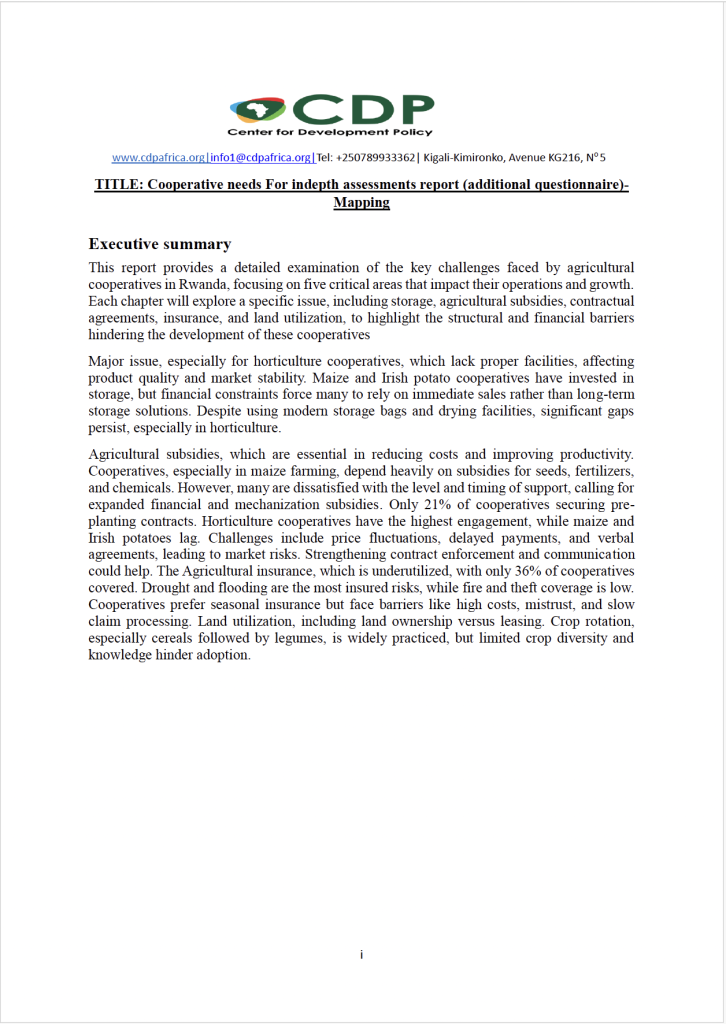
This report provides a detailed examination of the key challenges faced by agricultural cooperatives in Rwanda, focusing on five critical areas that impact their operations and growth. Each chapter will explore a specific issue, including storage, agricultural subsidies, contractual agreements, insurance, and land utilization, to highlight the structural and financial barriers hindering the development of these cooperatives
Study onWomen and Youth Trade

GIZ and the Ministry of Trade and Industry (MINICOM) commissioned this study aiming at examining challenges encountered by women and youth in trade, and how the same group can exploit the opportunities presented by the African Continental Free Trade Area (AfCFTA). The findings of this study inform the position paper that articulates the policy positions for Rwanda and is used by Rwanda’s negotiation team during upcoming negotiations for the Women & Youth Protocol under AfCFTA Phase II&III.
Untapped Potential Behind Intra-African Trade
This study aimed at building an evidence base of existing policies, strategies, interventions and stakeholders
contributing to the economic empowerment of WICBT in Rwanda. The aim of the study was to assess how the
existing interventions are contributing to the economic empowerment of WICBT in Rwanda. This study employed
a mixed research methods. Besides review of the literature and secondary data analysis, both focus group
discussion and key informant interviews were used to collect primary data.
In-depth Assessment Report of Agriculture cooperatives In Rwanda
Agriculture remains the backbone of Rwanda’s economy, contributing
significantly to employment, food security, and national GDP. As reported by Rwanda Development Board,
agriculture serves as the primary source of employment in Rwanda’s economy for 64.5% of the population and the industry contributes about 25% to GDP, and it stands out as one of the most strategic sectors in Rwanda’s development ((https://rdb.rw/, 2025). Despite its
critical and strategic role, the sector faces several challenges, particularly for youth and women, who struggle to access finance, business development services, and market opportunities.